25 - Loading Models
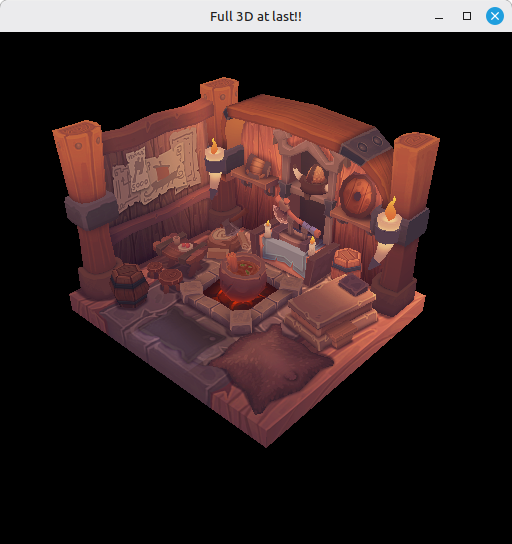
We’ve been hand-typing vertices since step 17 - two quads, twelve indices, a couple of z values. That chapter is closed. This step loads the viking room mesh from a .obj file and feeds it straight into the buffers we already have.
The full source for this step lives in src/25_loading_models/main.odin.
The corresponding chapters in the Vulkan Tutorial are:
- Khronos version: https://docs.vulkan.org/tutorial/latest/08_Loading_models.html
- vulkan-tutorial.com version: https://vulkan-tutorial.com/Loading_models
What’s new, in one glance
- An OBJ loader under
libs/tinyobj, imported withimport tinyobj "../../libs/tinyobj". A port oftinyobjloader-c, no official Odin port exists. load_modelreads the.objand builds our[]Vertexand[]u16directly fromobj.attrib.verticesandobj.attrib.faces.- The hardcoded
verticesandindicesslices are gone.maincallsload_model("../../assets/models/viking_room/viking_room.obj")and feeds the result into the unchanged buffer code. - No vertex deduplication. More on that below.
- Texture coords get a Y flip on the way in.
- Texture switches from JPEG to PNG and now lives next to the model under
assets/models/viking_room/.
An OBJ loader for Odin
The Vulkan Tutorial relies on the C++ tinyobjloader. Odin has no official equivalent. I grabbed a community port, adapted it to what I needed here, and put it under libs/tinyobj (libs/tinyobj/tinyobj_loader.odin). It’s a port of tinyobjloader-c, itself a C port of tinyobjloader. Same parsing logic, in Odin.
The relative import works because Odin resolves it against the file’s own directory:
import tinyobj "../../libs/tinyobj"
The API we care about is small:
FLAG_TRIANGULATE :: 1 << 0

Vertex_Index :: struct {
    v_idx:  int,
    vt_idx: int,
    vn_idx: int,
}

Attrib :: struct {
    vertices:       [dynamic]f32, // 3 floats per vertex
    normals:        [dynamic]f32,
    texcoords:      [dynamic]f32, // 2 floats per texcoord
    faces:          [dynamic]Vertex_Index,
    // ...
}

parse_obj :: proc(buf: string, base_dir: string = "", flags: u32 = 0) -> (o: OBJ)
parse_obj takes the file content as a string (we read the file ourselves), a base_dir to resolve anything the .obj references by name, and a flags field. We pass FLAG_TRIANGULATE so n-gons get fan-triangulated into triangles. The viking room is already made of triangles, but triangulate-by-default is the right reflex for arbitrary OBJ files.
The returned OBJ owns [dynamic] arrays that won’t go away on their own. We defer tinyobj.destroy(&obj) right after the parse:
obj := tinyobj.parse_obj(string(data), current_dir, tinyobj.FLAG_TRIANGULATE)
if !obj.success {
    fmt.eprintln("Failed to read obj file:", path)
    os.exit(1)
}
defer tinyobj.destroy(&obj)
By the time the defer runs we’ve already copied what we need into our own Vertex and index slices. Forget the destroy and those dynamic arrays leak - not catastrophic for a single load, but in a loop that reloads meshes you’ll watch memory climb.
Reading the OBJ
load_model :: proc(path: string) -> (vertices: []Vertex, indices: []u16) {

    data, err := os.read_entire_file(path, context.allocator)
    if err != nil {
        fmt.eprintfln("Failed to read obj file: %v, error: %v", path, err)
        os.exit(1)
    }
    defer delete(data)

    current_dir := slashpath.dir(path)
    defer delete(current_dir)
    obj := tinyobj.parse_obj(string(data), current_dir, tinyobj.FLAG_TRIANGULATE)
    if !obj.success {
        fmt.eprintln("Failed to read obj file:", path)
        os.exit(1)
    }
    defer tinyobj.destroy(&obj)
current_dir is the directory part of the path. The tinyobj loader uses it to resolve mtllib references inside the .obj (more on the .mtl below).
No vertex deduplication
This is where I part ways with the Vulkan Tutorial. The tutorial walks shapes, and for every face vertex looks up a (pos, texCoord, normal) triple in a map - reuse it if it already exists, push a new vertex otherwise. That dedup is needed in that code path, because each face vertex of a shape is reconstructed fresh.
This loader exposes attrib.vertices and attrib.faces directly. Each Vertex_Index in faces already references a vertex by v_idx. The natural way to consume that is one Vertex per v entry, with indices pointing into that array:
vertices = make([]Vertex, len(obj.attrib.vertices) / 3)
for f_index in 0 ..< len(vertices) {
    v := Vertex {
        pos   = {obj.attrib.vertices[f_index * 3], obj.attrib.vertices[(f_index * 3) + 1], obj.attrib.vertices[(f_index * 3) + 2]},
        color = {1.0, 1.0, 1.0},
    }
    vertices[f_index] = v
}

indices_list: [dynamic]u16
for &vertex_index in obj.attrib.faces {
    append(&indices_list, u16(vertex_index.v_idx))

    texCoord := vec2{obj.attrib.texcoords[vertex_index.vt_idx * 2], 1.0 - obj.attrib.texcoords[(vertex_index.vt_idx * 2) + 1]}
    vertices[vertex_index.v_idx].texCoord = texCoord
}

indices = indices_list[:]
return
Vertices are filled straight from attrib.vertices: three floats per position, len(attrib.vertices) / 3 of them. Color is white - the texture provides it now.
Then we walk attrib.faces. With FLAG_TRIANGULATE on, it’s a flat list of Vertex_Index triples. Each v_idx is exactly what we want in the index buffer, so we just append u16(vertex_index.v_idx). The texcoord is looked up through vt_idx and written back to the matching Vertex.
This works because the viking room - and most Blender exports with UV maps - has its v array already corner-deduplicated: a position shared by several UV islands gets multiple v entries, one per distinct UV. When the same v_idx shows up in several faces, those faces all agree on the texcoord, so writing it back to vertices[v_idx].texCoord more than once is harmless. If a model violated that assumption (same v_idx reused with different vt_idx), the last write would win and you’d get smears on the seams. For those models you’d switch to the deduplicating approach from the tutorial. For the viking room it’s fine, and it skips a map lookup per vertex.
Indices stay u16. The viking room has 4675 vertices and ~11k indices, well inside u16 range. Switch to u32 once you pass 65535 vertices - CmdBindIndexBuffer is told .UINT16 in src/25_loading_models/main.odin:1020, and that has to track your index type.
The vertex and index buffer creation code, the staging upload, the descriptor set update - none of it changes. The only difference in main is where vertices and indices come from:
vertices, indices := load_model("../../assets/models/viking_room/viking_room.obj")
That relative path resolves from the working directory src/25_loading_models. If you run the executable from somewhere else, adjust the path - the binary doesn’t embed any assets.
The Y flip on texture coordinates
That 1.0 - ... on the texcoord V is not a typo:
texCoord := vec2{obj.attrib.texcoords[vertex_index.vt_idx * 2], 1.0 - obj.attrib.texcoords[(vertex_index.vt_idx * 2) + 1]}
OBJ stores UVs with the origin at the top-left, V growing downward. Vulkan (and most graphics APIs) has the texture origin at the bottom-left, V growing upward. Copy vt straight through and the texture renders upside down. 1.0 - v puts it where our sampler expects.
You sometimes see people flip the image instead, or flip in the shader. Flipping on load happens once per vertex, not per fragment, and keeps the shader untouched. The flip is baked into the vertex data though - if you reuse the same vertices with an API that expects top-left UVs you’d have to un-flip. Not a concern here.
From JPEG to PNG
Two small changes follow the new texture. The import switches from core:image/jpeg to core:image/png:
import img "core:image/png"
The matching _ :: png line at the top of the file (the one that keeps the “unused import” warning quiet while still registering the PNG decoder with core:image) flips with it. The texture path then points at the viking room PNG:
image, image_memory := create_texture_image(physical_device, device, "../../assets/models/viking_room/viking_room.png", command_pool, graphics_queue)
Nothing else in create_texture_image changes. The proc doesn’t care what file format the bytes came from - it gets pixels from img.load, assumes four channels, and uploads. We just switched because that’s how the viking room texture ships.
A small detail worth mentioning since you’ll see the file in the repo: the .obj from the vulkan-tutorial.com assets references a material library with mtllib viking_room.mtl, but the .mtl wasn’t shipped with it. tinyobj prints TINYOBJ: Error reading material file: ... when it can’t find an mtllib - harmless but noisy. I dropped a hand-written viking_room.mtl next to the .obj just to silence it. We don’t read anything from it, the texture path is hardcoded in main, so feel free to ignore the .mtl entirely.
Test it
The startup log mirrors step 24 up to Draw fence... OK, then a new Model loaded... OK line shows up between the fences and the buffer creation:
Model loaded... OK
Vertex buffer... OK
Vertex copied to buffer using staging buffer... OK
Index buffer... OK
Indices copied to buffer using staging buffer... OK
Image loaded 1024 x 1024, channels: 4
Texture image loaded... OK
The window title is now “Full 3D at last!!”. Instead of two rotating quads you see the viking room, turning around the z axis, with the texture wrapped around it. Depth is still on, so the back wall is correctly occluded by the front. The texture should look the right way up - if it’s flipped vertically, you forgot the 1.0 - ... on the texcoord V.
Errors you might hit:
- “Failed to read obj file”: the
.objpath doesn’t resolve from where the executable runs. The working directory has to besrc/25_loading_models. - “Failed to open image file”: same path issue, the PNG has to sit at
assets/models/viking_room/viking_room.pngfrom the step’ssrcfolder. - Garbled UVs on the seams, streaks across the model: the “same
v_idxreused with differentvt_idx” case, which shouldn’t happen on the viking room but might on other meshes. Switch to the deduplicating approach from the tutorial. - Validation errors about a buffer being too small or an index out of range: check that
len(indices), theindex_countpassed toCmdDrawIndexed(src/25_loading_models/main.odin:1027) and the index buffer size all agree.
What’s next
We’ve gone from a hand-staged quad to a real textured mesh loaded from disk, all riding on the buffer/descriptor/depth plumbing built in the previous steps. The viking room texture is 1024x1024 and gets sampled once per fragment regardless of how far the surface is on screen - fine close up, noisy and bandwidth-heavy once the model shrinks in the distance. The next step, 26 - Mipmaps, adds a mip chain to the texture image so the GPU can pick a lower-resolution level for distant fragments, cheaper to sample and easier on the eyes.